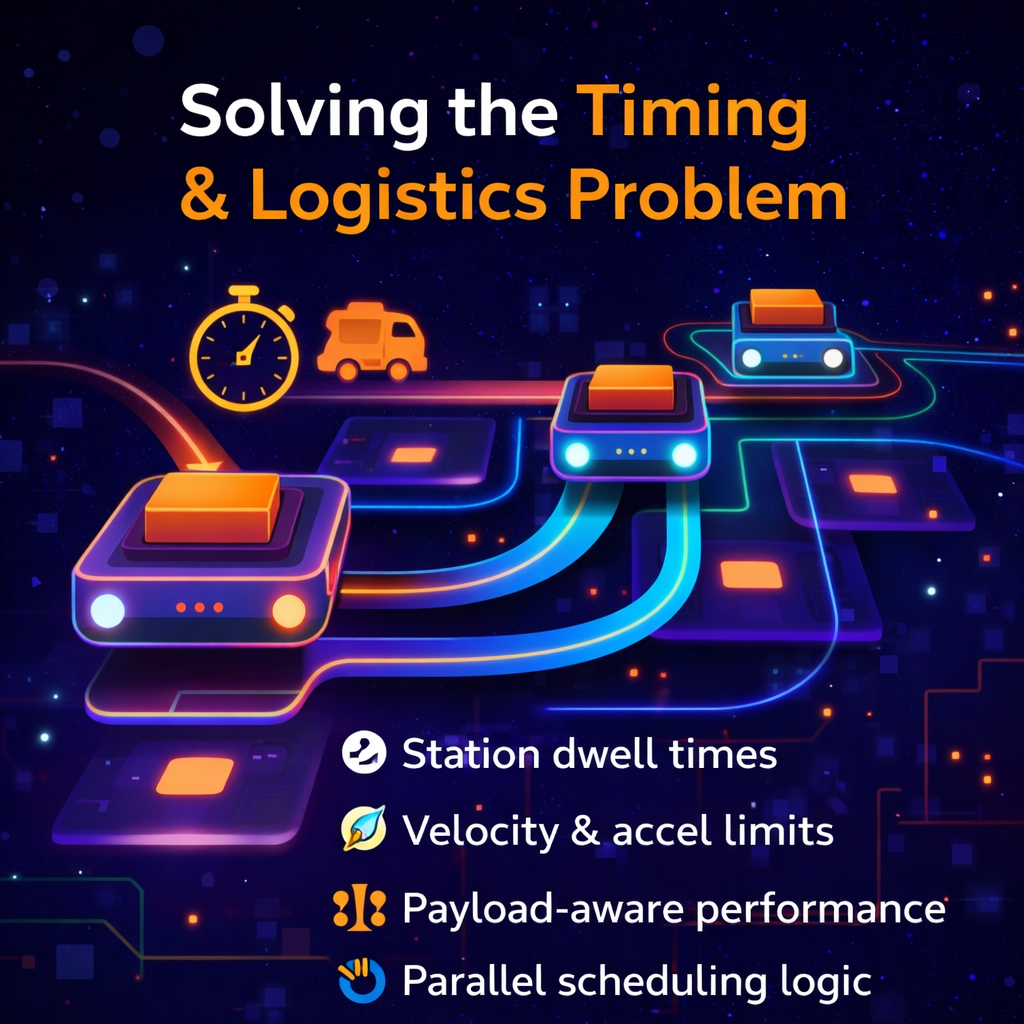
In high-speed systems like Beckhoff XPlanar and XTS, physics is rarely the first bottleneck—timing and logistics are. During presales and concept design, the real question isn’t friction coefficients or thermal maps. It’s: Can we hit throughput targets? Do we need more movers? Will station dwell times create bottlenecks? That’s where most simulation workflows slow down. Traditional tools require days—or weeks—of setup before engineers can even test cycle timing scenarios.
We focused on solving this exact problem inside NVIDIA Omniverse with AI-assisted simulation. Instead of starting with full PLC logic, we built a workflow that allows engineers to:
By shifting the focus to logistics modeling, deterministic mover coordination, and cycle-time optimization, the simulation becomes analytically valuable—not just visually impressive. Instead of hardcoding motion paths, we parameterize system behavior and evaluate performance under realistic operating constraints. This allows engineers to simulate multi-mover workflows before PLC logic is finalized and hardware is deployed.
Key technical elements include:
By simulating queue formation, inter-station dependencies, and minimum mover requirements per process step, we can identify bottlenecks early and validate cycle stability under different production targets. The result is a data-driven digital twin that acts as a pre-commissioning logistics engine—helping teams optimize capacity, mover count, and station layout before writing full PLC logic.
If timing and logistics are slowing down your XPlanar projects, it’s time to rethink simulation. 🚀 Book a demo with Champion and see how AI-powered Omniverse workflows can accelerate your presales and system design process.